Digital ID Systems in Europe – The Hidden Cybersecurity Risks Behind Convenience
Published: 20 Oct 2025
Digital ID Systems in Europe are transforming the way people live, work, and connect online. Across the continent, the push toward digital identity systems promises a future where logging in, verifying your age, or accessing healthcare happens with a single tap. The European Digital Identity Wallet and national eIDs are designed to make life faster, simpler, and more connected than ever before. But behind that convenience lies a growing debate — how much security and privacy are citizens giving up in exchange for ease of use?
As governments and private sectors rush to unify identification under one secure framework, experts warn that convenience often comes with hidden vulnerabilities. From centralized databases that could become cyberattack goldmines to identity theft risks that could ripple across multiple services, Europe’s digital ID revolution is a balancing act between innovation and protection.
Digital ID systems are not just about technology — they are about trust, control, and the right to privacy in a world that’s becoming increasingly digitized. Understanding how these systems work — and where they might go wrong — is essential for every citizen, policymaker, and business leader shaping Europe’s digital future.
1. How Europe’s Digital-ID Push Works: Wallets, National eIDs, and eIDAS 2.0
Europe is undergoing a major shift in how identity is handled online, moving beyond traditional national identity cards and country-specific electronic identification (eID) systems. At the center of this transformation is the combination of three key elements: national eIDs, the European Digital Identity Wallet, and the eIDAS 2.0 regulation — a new EU-wide framework designed to make digital identities secure, portable, and interoperable across all member states.
To understand how this system works, it helps to see how it evolved. Many European countries have already issued national eIDs that allow citizens to identify themselves and sign documents online. These include Estonia’s ID-card system, Sweden’s BankID, and Finland’s eID solutions — all of which are used for logging into public services, banking, healthcare, or even voting. However, these systems were designed at the national level, meaning a citizen from one country could not easily use their eID to access services in another. This lack of cross-border compatibility became a major barrier to Europe’s digital single market.
That’s where the original eIDAS Regulation (EU No 910/2014) came in. It established the legal foundation for the mutual recognition of national eID schemes across EU countries. The aim was simple: if you have a government-issued eID in your home country, you should be able to use it to access public services anywhere else in the EU. While this was a breakthrough in principle, adoption was uneven. Many states implemented eID schemes differently, with varied levels of assurance and technical standards, which made smooth interoperability difficult.
To fix these issues, the EU introduced eIDAS 2.0, the updated regulation that takes Europe’s digital-identity framework to the next level. The central innovation is the creation of a European Digital Identity Wallet (EUDI Wallet) — a mobile-based app that every member state must offer to its citizens and residents. This wallet acts as a secure container for digital identity credentials, verified attributes (like a driver’s license, university diploma, or proof of age), and digital signatures. Unlike traditional eIDs that rely on centralized databases, the wallet is user-controlled, giving individuals the power to choose what data to share and with whom.
This wallet also goes beyond public services. Under eIDAS 2.0, both public and private organizations — from government portals to banks, telecom companies, and healthcare providers — will be required to accept the wallet as a form of verified digital identity. This expansion is crucial because it brings the convenience of one-click authentication to nearly all aspects of online life while maintaining high security and privacy standards.
Technically, the EU’s Architecture and Reference Framework (ARF) defines the standards for these wallets. It sets detailed rules for data formats, encryption protocols, consent handling, and cross-border interoperability. The wallets must achieve a “high level of assurance,” meaning that identity verification and credential issuance meet strict security and cryptographic requirements. The EU also encourages open-source implementations to ensure transparency and public trust.
Each member state will be responsible for issuing at least one compliant wallet or authorizing a provider to do so. These wallets must be interoperable across Europe — meaning that a citizen from France can use their wallet to open a bank account in Germany or verify their identity for an online service in Italy. Behind the scenes, service providers verify the digital credentials through secure, standardized interfaces while respecting the principle of data minimization — sharing only what’s necessary for the transaction.
Importantly, eIDAS 2.0 doesn’t erase existing national eIDs — it builds on them. The digital wallet will often use the national eID as a base credential or trust anchor. This approach preserves national control while allowing EU-wide functionality. For example, a German citizen’s wallet may rely on their BundesID for identity verification, while an Estonian’s wallet might link to their existing e-Residency or ID-card system.
From a timeline perspective, the political agreement on eIDAS 2.0 was reached in 2023, and the regulation formally entered into force in 2024. Member states now have a few years — roughly until 2026 — to implement fully operational wallets. Several pilot projects, such as those testing mobile driver’s licenses, university credentials, and cross-border healthcare access, are already underway in countries like Spain, Denmark, and Finland.
For citizens, the benefits are clear: no more dozens of passwords, no repeated identity checks, and seamless access to both domestic and EU-wide services from a single digital wallet. For governments and businesses, this creates a trusted identity infrastructure that reduces fraud, streamlines verification, and supports the digital single market.
However, this convenience also introduces new challenges. The integration of national eIDs into a unified European wallet expands the cybersecurity attack surface and requires flawless coordination between public and private actors. Robust governance, technical audits, and transparency will be essential to maintain security and user confidence as the system scales.
In short, Europe’s digital-ID initiative represents a bold step toward a unified, user-centric digital identity framework. It builds on the success of national eIDs, harmonizes them under eIDAS 2.0, and introduces the European Digital Identity Wallet to make identity verification faster, safer, and truly borderless.
2. User Convenience: What Citizens Actually Gain (Speed, Services, Fewer Logins)
Across Europe, digital identity systems are transforming the way citizens interact with both public institutions and private services. Instead of juggling multiple passwords, logins, and paper documents, Europeans can now verify their identities securely through one central system. This shift is at the heart of the European Union’s digital transformation strategy, designed to make daily life simpler, faster, and more connected.
One of the most visible benefits of a unified digital ID system is speed. Services that once required long queues or physical visits can now be accessed instantly online. For example, renewing a driver’s license, submitting tax returns, or signing up for healthcare services can be completed within minutes using verified digital credentials. This seamless verification process saves not only time but also reduces the administrative load on governments and organizations that handle millions of identity checks every year.
Another major gain is accessibility. Digital IDs remove many of the barriers citizens face when dealing with cross-border services within the EU. A person from France can use their national eID to access educational or financial services in Germany or Italy without needing a separate login or physical verification. This creates a sense of digital unity within the EU — a single identity framework that follows citizens wherever they go, both physically and online.
For everyday consumers, the benefits go beyond government platforms. Banks, insurance companies, telecom providers, and even e-commerce platforms are integrating digital ID systems to streamline onboarding and verification. Instead of manually uploading documents or visiting a branch, users can verify their identity in seconds using their national eID or the upcoming European Digital Identity Wallet. This wallet acts as a secure digital container, storing credentials like passports, health cards, and driver’s licenses — all under the user’s full control.
The healthcare sector is also seeing remarkable improvement. Patients can access electronic health records, book appointments, or transfer prescriptions between countries with verified digital identities. For professionals, it means secure access to patient data without delays, enhancing both treatment speed and accuracy. During crises, such as pandemics, this level of connectivity proves invaluable in sharing verified medical information safely across borders.
Furthermore, digital IDs reduce the need for repetitive logins and form-filling. Single sign-on (SSO) solutions linked to trusted digital identities mean users no longer have to remember countless usernames or passwords. A verified ID login ensures faster authentication with higher security — combining convenience with trust. This also strengthens cybersecurity by minimizing password reuse, one of the most common causes of data breaches.
Businesses also benefit from this ecosystem. With citizens able to authenticate securely and instantly, companies can focus on providing services rather than verifying identities. This accelerates digital transformation across sectors, encouraging innovation and fostering public trust in online systems.
In the broader sense, digital identity programs represent a shift toward smarter living. They empower citizens to handle life’s essential tasks — from applying for jobs to renting apartments — through one digital touchpoint. The ability to carry official documents securely in a digital wallet enhances mobility, productivity, and inclusion.
However, this convenience depends on maintaining a delicate balance between accessibility and data protection. The next stages of the EU’s initiative will determine how far these benefits can go without compromising user privacy or security.
3. Design Choices That Trade Privacy for Usability
When the drive to streamline online access and boost user convenience meets identity infrastructure, system designers often face a hard trade-off between privacy and usability. The choices made in architecture, data sharing, and user workflows shape not just how easy things are to use—but also how much control the user has over their personal information. In the context of Europe’s digital-identity push, understanding these trade-offs is critical.
One of the first decisions is around data collection scope. A system built purely for convenience may lean toward having a full identity credential—a digital token that essentially replicates a physical ID card with name, photo, birthdate, address, and other attributes. The user presents this to services, often with minimal further checks. From a usability standpoint, this is simple: hold one credential, show it when needed. But privacy-wise, it means each service gets a rich data set, and users give up a degree of control over what they share. If their digital wallet isn’t designed for selective disclosure, they may end up oversharing.
In contrast, privacy-centric systems give the user tools like attribute-based credentials or selective disclosure. For example, rather than revealing your full date of birth, you only verify “over 18” or “resident in country X”. Rather than showing your full identity, you show that you hold an identity credential issued by a trusted issuer without revealing all details. These techniques reduce the exposure of personal data and thus reduce risks of data breaches or misuse. However, from a usability standpoint, they may require more sophisticated technology (zero-knowledge proofs, advanced cryptographic protocols) or additional steps for the user (choosing which attribute to share, verifying the issuer). That extra complexity can slow adoption.
Another major design axis is centralisation vs decentralisation of data storage and governance. A centralized model might store verified identity credentials or metadata about them in a national database. From a convenience angle, centralisation simplifies management, issuance, updates, revocation, and cross-service access. A single source of truth can make integration with services smoother and speed up onboarding. But privacy advocates warn that central repositories become high-value targets: if breached, they reveal large amounts of user information, or permit mass surveillance. It also concentrates control in the hands of a single entity—raising questions about governance, transparency, and oversight.
A decentralised or federated model shifts responsibility and storage closer to the user or to different trusted issuers. For example, the wallet may store the credentials locally on the user’s device, or use distributed ledger techniques, with relying services verifying credentials without needing to query a central server. This enhances privacy and user autonomy, but from a usability perspective, it may introduce device-compatibility issues, recovery challenges (if the device is lost), and potential interoperability hurdles across services and countries.
Cross-border operation adds another layer of complexity. Because the EU’s digital identity system is intended to be used across Member States, design choices must balance national convenience with harmonised standards. Some systems may default to full identity sharing simply because it aligns with existing national eID frameworks which were designed for domestic use. When ported across borders, such models may fail to accommodate more privacy-friendly selective disclosure. Member states choosing simpler models may gain speed and uptake domestically, but risk placing users’ privacy at a disadvantage compared to systems designed with privacy from the ground up.
In addition, the choice between public-sector issuance only versus including private-sector attribute providers has privacy implications. If a national wallet allows a bank, telecom or other private entity to issue or hold the credentials or attributes, there is a heightened risk of data being used for commercial profiling or shared across parties for marketing. Convenience may increase—users can use one wallet to access both government and private services—but the boundary between identity verification and data monetisation may blur, reducing transparency and user control.
Crucially, the user-interface design matters too: how many clicks, how visible are the privacy options, how clearly is the user informed about which data is being shared, and whether they can revoke or audit usage. A system that hides complex privacy settings behind menus may technically allow selective disclosure, but in practice users default to “share all” because it’s easiest. That leans toward usability but at cost of actual meaningful privacy.
Recovery and fallback mechanisms also reflect design trade-offs. For high convenience, systems might allow easy “lost-wallet” recovery via simple identity verification or minimal checks—great for usability, but potentially less secure and more risky for privacy if fallback flows are weaker. Conversely, a system with very secure recovery (multi-factor, identity proofing, manual intervention) is stronger for privacy/security—but may frustrate users and hamper adoption.
The governance model also influences how privacy is weighed. If the issuing authority mandates wide data sharing or doesn’t enforce strict purpose limitation, the convenience of “just one wallet works everywhere” may lead to incremental feature creep: the wallet starts being used for services beyond what the user expected, or for profiling and analytics. A system designed with strong privacy governance will have clear boundaries: what attributes can be included, who can access them, how long they’re held, and how users control them. This may slow down uptake or require more policy work—but supports long-term trust.
In practice, several European pilot systems have already illustrated how design choices matter. Some national wallets emphasise linking many services quickly and mandating use, thereby offering high convenience but raising concerns about over-centralisation and large-scale attribute sharing. Other wallets prioritise user choice, device-level control, and minimal data sharing—but rollout has been slower, and some users find them less straightforward.
In summary: design choices in Europe’s digital-identity ecosystem reflect a spectrum—from high-convenience, high-sharing models to high-privacy, selective-sharing models. Usability and convenience tempt system architects to adopt simpler, full-credential, centralised flows. But privacy advocates remind us that each simplification carries risk: over-sharing, reduced user control, mass surveillance potential, and increased exposure to breaches. The optimal path lies in striking a balance: user-centric convenience that does not sacrifice meaningful privacy and control. As Europe’s digital ID wallets become operational, the systems that succeed will be those that treat usability and privacy not as trade-offs, but as coequal design goals.
4. The Expanding Attack Surface: New Frontiers of Cyber Risk
As Europe’s digital identity ecosystem grows more interconnected, so does the potential for large-scale cybersecurity incidents. Every new service integrated into the digital ID network — from banks and hospitals to e-commerce and transport apps — adds another potential entry point for attackers. The very integration that brings convenience also expands the “attack surface” — the total number of points where unauthorized access could occur. To understand how these threats evolve and how individuals can protect themselves, explore our detailed Cybersecurity and Data Privacy Guide for deeper insights into securing your digital footprint.
The first and most obvious concern is centralized data breaches. Many national digital ID systems rely on central repositories that manage or verify user credentials. Even when personal data is encrypted, these servers remain prime targets for hackers, cybercriminal groups, and even state-backed actors. A single successful breach could expose millions of citizens’ identities at once — not just names and addresses, but verified credentials used for accessing sensitive services like healthcare or banking. Because such data is difficult to revoke once compromised, the effects can persist for years, making recovery nearly impossible for affected users.
Next comes the growing threat of credential theft. Digital ID systems are designed to simplify authentication — but this also means a single credential can unlock many services. If an attacker gains access to one person’s verified digital ID, they could impersonate that individual across multiple platforms. Imagine a single compromised wallet allowing unauthorized access to tax records, medical files, or bank accounts. This creates a domino effect: one breach doesn’t just affect one system, it cascades across an entire ecosystem of connected services.
This is where malware and device-level attacks become particularly dangerous. Since most digital ID wallets are stored on smartphones, attackers can use mobile malware to intercept authentication tokens or inject malicious code during sign-ins. Even sophisticated users can be tricked by phishing attacks that mimic legitimate government or service-provider interfaces. Once malware infiltrates the device or digital wallet, it can silently harvest credentials, alter transactions, or even approve access requests without the user’s knowledge.
Another growing concern is API and integration vulnerabilities. Digital ID systems rely heavily on APIs (Application Programming Interfaces) to connect with third-party apps and services. Every API endpoint is a potential vulnerability — especially if not properly secured or monitored. Poorly implemented API gateways can be exploited to extract sensitive data or perform unauthorized operations, bypassing even strong authentication controls. Attackers may also exploit “trust chains” between services — using a compromised lower-level system to gain access to higher-privileged platforms that rely on it.
Phishing and social engineering are equally pressing threats. Even the most secure system can fail if users are manipulated into revealing credentials or approving fake requests. In some cases, attackers may clone the design of official digital ID apps or government portals to deceive citizens into logging in. Once the attacker obtains temporary session tokens or passwords, they can exploit them to access multiple linked services. Because these tokens are often short-lived, traditional cybersecurity tools may not detect the intrusion in time.
Another dimension is the risk of cascading failures. When a single digital identity is tied to dozens of critical services, one compromise can trigger a systemic collapse. For instance, if a malicious actor takes over a citizen’s digital wallet, they could potentially alter medical prescriptions, file fraudulent tax claims, or transfer assets — all before detection. On an institutional level, if a national verification server or certificate authority is compromised, millions of citizens could be locked out or impersonated simultaneously. This “single point of compromise” risk is one of the biggest challenges for Europe’s vision of interconnected digital identity infrastructure.
Malicious insiders and supply chain attacks further amplify these concerns. Even if the system’s architecture is secure, vulnerabilities may enter through third-party software, updates, or even hardware used in the ID verification process. A compromised developer account or malicious firmware update could silently introduce backdoors. Attackers increasingly target these indirect routes because they bypass traditional defenses, making detection difficult and mitigation slow.
Emerging technologies like quantum computing could also disrupt current cryptographic protections. While this threat is still developing, experts warn that quantum attacks could render existing encryption algorithms vulnerable — potentially exposing vast stores of encrypted identity data in the future. The transition to quantum-safe cryptography will therefore be critical to maintaining the long-term integrity of European digital IDs.
Finally, there’s the issue of incident response and resilience. Many digital ID systems lack clear, user-friendly mechanisms for recovery or damage control after compromise. If a wallet is hacked, revoking and reissuing credentials across all services can take weeks or even months — leaving users exposed in the meantime. For governments, coordinating a cross-border response to such incidents is logistically complex, given differing national regulations and infrastructures.
In summary, Europe’s expanding digital ID framework introduces a double-edged reality: while it simplifies access and boosts digital efficiency, it also creates a dense, interconnected web of potential vulnerabilities. The convenience of “one identity for all” must be balanced with robust technical safeguards, decentralized trust models, and rapid-response mechanisms. Otherwise, the same system built to enhance trust in digital life could become a powerful tool for exploitation.
5. Real-World Lessons: When Digital IDs Have Gone Wrong
Digital ID systems promise efficiency, transparency, and trust — but even the most advanced designs can fail under real-world conditions. Across Europe and beyond, several major incidents have revealed just how fragile large-scale identity infrastructures can be when cryptography, governance, or procedures break down. These cases offer valuable insight into what can go wrong, and what Europe must learn as it rolls out its next-generation digital ID frameworks.
One of the most famous examples is the Estonian ID card vulnerability discovered in 2017. Estonia’s national ID card system was widely considered the gold standard of digital governance — used by more than 1.3 million citizens to vote online, access healthcare, file taxes, and even sign legal contracts. However, a cryptographic flaw was found in the chips used for these smart cards, supplied by an international manufacturer. The flaw stemmed from weak key-generation methods that could allow attackers to mathematically derive private keys from public information. In simple terms, a hacker could potentially clone the card’s identity and impersonate the user.
The vulnerability was purely mathematical — no exploit had yet been seen in the wild — but it shook public trust in one of the world’s most advanced e-ID systems. The Estonian government had to suspend affected cards, issue emergency software updates, and later replace over 700,000 cards. While the quick response prevented major damage, the incident revealed how dependent even the most secure system can be on its cryptographic underpinnings and external suppliers. It also underscored the risk of supply-chain dependence — national security resting on third-party hardware or algorithms that may contain undiscovered weaknesses.
Another instructive example comes from India’s Aadhaar system, one of the largest biometric ID programs globally. Although not European, it demonstrates how scale introduces vulnerability. Aadhaar’s database contains biometric and demographic data of more than a billion citizens. Over the years, multiple data leaks — often from poorly secured third-party service providers — exposed millions of records. The core database itself was not breached, but partner integrations failed to protect sensitive information. These incidents highlighted how even if the central infrastructure is secure, ecosystem-level weaknesses (such as careless API use or poor encryption by smaller partners) can compromise the entire trust model.
Closer to Europe, the United Kingdom’s Verify program provides a lesson in usability and adoption challenges. Designed to give citizens a single digital identity for government services, it suffered from poor user experience and lack of private-sector integration. Many users found the onboarding process too complex, identity verification unreliable, and service coverage too narrow. Adoption lagged far behind expectations, and the government eventually announced plans to phase out the platform. The takeaway was clear: even if a digital ID system is secure, without usability and broad adoption, it fails to deliver on its promise.
Similarly, Denmark’s NemID, which was once a pioneer in online authentication, faced criticism for relying on outdated security models and centralised architecture. Users were required to carry printed code cards, which led to phishing attacks and credential theft. The transition to a new system, MitID, was meant to address these flaws by using app-based authentication and stronger encryption. However, the migration itself caused temporary outages and confusion, revealing how system upgrades and transitions can be points of vulnerability if not planned with resilience and user education in mind.
Even smaller-scale incidents illustrate key weaknesses. In some European states, researchers have shown that QR-code-based digital certificates used for COVID-19 passes could be forged using publicly leaked signing keys or weakly protected private keys. While these were temporary systems, they serve as a warning that any digital credential tied to identity must be protected with enterprise-grade cryptography and monitored for tampering.
What ties these examples together is not just technical error, but the intersection of human, procedural, and design weaknesses. Cryptographic algorithms may be mathematically secure, but if the hardware vendor’s implementation is flawed, the system collapses. Software updates may be designed to patch vulnerabilities, but if communication with citizens is slow or confusing, public trust erodes faster than any technical repair can restore it. And even when all components work correctly, poor governance — such as lack of auditing, transparency, or clear responsibility — can turn a minor bug into a crisis of confidence.
These incidents also underscore the importance of continuous auditing and transparency. Estonia, to its credit, publicly disclosed the vulnerability, shared mitigation steps, and rebuilt public trust through openness. Contrast this with systems where governments or vendors initially denied problems — the secrecy only deepened suspicion and delayed remediation. Trust, once lost, is hard to rebuild, especially in systems designed to be the cornerstone of digital life.
In essence, these lessons demonstrate that building a digital ID system is not a one-time technical challenge; it’s an ongoing process of vigilance, upgrade, and governance. Europe’s upcoming Digital Identity Wallet must learn from these global experiences: ensure cryptographic agility, vet suppliers rigorously, test interoperability, plan for large-scale revocation, and above all, keep citizens informed.
Because in digital identity, the real measure of success is not how many people adopt it — but how resilient it remains when something inevitably goes wrong.
6. Privacy, Exclusion, and Civil-Liberties Concerns
As Europe pushes forward with digital identity systems designed to simplify online life, a quieter but equally urgent debate is emerging — one centered on privacy, inclusion, and civil liberties. While digital IDs promise efficiency and trust, they also have the potential to create unprecedented visibility into citizens’ lives. If these systems are not built with rigorous safeguards, they can inadvertently enable surveillance, data profiling, and even social or economic exclusion.
The first major concern is surveillance and data aggregation. A digital ID system, by design, links users to a wide range of public and private services — from banking and healthcare to education and transportation. This creates a detailed digital footprint that could, if mishandled, allow authorities or corporations to track when, where, and how citizens use services. Even if data collection is justified for verification, the aggregation of those logs into centralized systems opens the door to mass surveillance. Governments could theoretically map individuals’ behaviors, movements, or associations based on identity-linked transactions.
Such risks are not merely theoretical. In countries where digital identity frameworks lack strict data separation, it becomes easier for agencies to combine data across sectors. For example, information from healthcare, taxation, and travel records could be cross-referenced to profile individuals’ lifestyles or predict their behavior. This kind of cross-dataset profiling erodes the boundary between legitimate service provision and intrusive monitoring, raising questions about compliance with privacy principles under the EU’s General Data Protection Regulation (GDPR).
Data profiling by private entities is another growing threat. When digital IDs are used to access e-commerce platforms, financial services, or social applications, each login generates metadata — timestamps, device information, purchase patterns, and more. If aggregated, these records can build a comprehensive behavioral profile, allowing companies to target users with precision marketing or, worse, make algorithmic decisions that affect credit, insurance, or employment opportunities. Without strong anonymization and data-minimization policies, digital ID systems risk fueling a new era of data-driven discrimination.
Closely linked is the issue of purpose creep — when systems designed for one function gradually expand into others. A digital ID initially built for government services might later become mandatory for travel, housing, or job applications. While the goal might be administrative efficiency, it can slowly erode personal autonomy by making digital identification unavoidable. Citizens who prefer privacy, or who distrust digital systems, may find themselves effectively locked out of essential services — a quiet but profound form of coercion.
Equally pressing is digital exclusion. Not everyone in Europe has equal access to the technologies required to use digital ID systems. Older citizens, people in rural or low-income communities, and individuals with disabilities may lack the devices, connectivity, or technical literacy needed to manage digital wallets or online authentication tools. If physical alternatives like paper documents or in-person verification are phased out too quickly, millions could find themselves excluded from public services, banking, or healthcare.
This exclusion risk is amplified when identity verification depends on smartphones. Many digital ID wallets require specific operating systems, security updates, or biometric sensors. Those using older phones or shared devices may not meet these requirements. Moreover, some citizens may intentionally avoid carrying smartphones due to privacy or safety concerns. For them, digital identity becomes not a convenience, but a barrier.
There’s also the risk of algorithmic bias in biometric verification systems. If facial recognition or fingerprint matching is used to authenticate users, errors or unequal accuracy rates across demographic groups can lead to discrimination. Studies have shown that facial recognition technologies can misidentify people with darker skin tones or women at higher rates than other groups. In a national identity context, such errors can translate into denial of access to services, wrongful flagging, or reputational harm.
Privacy advocates also warn against data retention and unclear governance structures. If governments or private issuers retain authentication logs indefinitely, it becomes nearly impossible for users to know who accessed their data, for what reason, or for how long it’s stored. Transparency reports and audit trails must be mandatory to prevent silent data accumulation that could later be exploited for surveillance or commercial gain.
Civil-liberties organizations further caution that mandatory digital identity—where citizens must use the system to interact with authorities—blurs the line between voluntary participation and state-imposed monitoring. Once citizens depend entirely on digital credentials, they lose the option of anonymity in everyday life. Without careful design, such systems can resemble a “digital passport” for every online action, contradicting Europe’s long-standing commitment to individual rights and privacy by default.
To address these issues, Europe must embed privacy-preserving technologies and inclusion strategies into the very foundation of its digital ID systems. Concepts like zero-knowledge proofs, selective disclosure, and data minimization should be standard, ensuring that users share only what is necessary for each transaction. Governments should also mandate offline and non-digital alternatives for citizens unable or unwilling to participate, guaranteeing that access to essential services never depends solely on digital systems.
Finally, digital literacy and transparency must be core pillars of implementation. Citizens should know how their data is stored, when it’s accessed, and by whom. Regular public audits, open-source components, and citizen oversight councils could help maintain accountability and rebuild trust in systems that inevitably touch every aspect of life.
In essence, digital ID systems sit at a crossroads of technology and human rights. If implemented carelessly, they risk turning identification into surveillance and convenience into exclusion. But if designed with privacy, fairness, and inclusion at their core, they can embody Europe’s democratic values in the digital age — offering empowerment rather than control, and connection without compromise.
7. Who Holds the Keys? Public vs. Private ID Issuance Models
At the heart of Europe’s digital identity debate lies a deceptively simple question: who should control citizens’ digital identities — governments, private companies, or a partnership of both? The answer carries profound implications for accountability, security, and trust. Whether the system is state-led or driven by private entities like banks or tech firms, the “keyholder” determines how identity data is issued, stored, and verified — and ultimately, who bears responsibility when things go wrong.
Government-Controlled Models: Authority and Accountability
In government-controlled digital ID systems, the state acts as the sole issuer and guarantor of identity credentials. This model emphasizes public trust, legal accountability, and democratic oversight. Citizens generally view governments as legitimate custodians of identity since the state already manages foundational registries — such as passports, national IDs, and civil records.
A state-run approach provides clear lines of responsibility. If a breach or misuse occurs, the government is directly accountable under national and EU privacy laws. Moreover, public-sector oversight mechanisms — including data protection authorities and parliamentary review — can ensure transparency in how identities are issued and verified. Because governments are bound by frameworks like the General Data Protection Regulation (GDPR) and the EU Digital Identity Regulation (eIDAS 2.0), they must comply with strict standards on data minimization, consent, and user control.
However, this model also has weaknesses. Centralized state databases can become attractive targets for cyberattacks. A single security failure could expose millions of citizens’ personal data. Additionally, if not properly constrained by law, government-led systems risk overreach — potentially enabling surveillance or the linking of identity data across multiple sectors. Citizens in some EU member states remain wary of government data handling due to historical misuse of personal information. Thus, while state control offers legal accountability, it must be balanced with technical decentralization and independent oversight to prevent concentration of power.
Private and Bank-Led Models: Innovation and Risk
On the other hand, private-sector or bank-led digital ID systems — already active in countries like Sweden (BankID) and Norway — promise innovation, efficiency, and user convenience. In these models, private institutions issue and manage identity credentials under regulatory approval, often leveraging their established trust relationships with customers. Banks, telecoms, or technology providers typically have the technical infrastructure, cybersecurity expertise, and customer-facing experience to make identity management smooth and user-friendly.
Private issuers can move faster than governments in adopting cutting-edge security measures like multi-factor authentication, decentralized wallets, and biometric encryption. They also tend to offer better user experience, integrating digital IDs seamlessly into apps and payment systems. This convenience often leads to higher adoption rates — BankID, for instance, is used by over 90% of Sweden’s adult population.
Yet, private models raise serious accountability and liability concerns. When identity systems are operated by commercial entities, who is responsible if data is leaked, misused, or manipulated? A private provider’s primary duty is to shareholders, not citizens. This introduces conflicts of interest: data could be monetized for marketing or analytics, undermining the very privacy principles digital IDs aim to protect. Even if governed by law, enforcement is difficult — cross-border private issuers complicate jurisdiction, and users often have little recourse beyond complex legal action.
Transparency is another sticking point. Private companies are not subject to the same open governance or freedom-of-information rules as public agencies. Their algorithms and decision-making processes often remain proprietary, making it difficult to verify whether users’ data is truly being handled ethically. As a result, trust — while high in certain sectors like banking — may erode if citizens feel that digital identity has become another product rather than a public right.
Hybrid Models: Balancing Control and Innovation
Recognizing the limitations of both extremes, the EU’s European Digital Identity (EUDI) Wallet proposal seeks a hybrid model that blends public oversight with private innovation. Under this framework, member states designate trusted issuers — which can include banks, telecoms, or certified private providers — but ultimate legal responsibility remains with the government. Citizens can then choose from multiple wallet providers, ensuring competition while maintaining a baseline of public accountability.
In this system, governments “set the rules,” but the private sector “builds the tools.” This balance ensures that security standards, transparency requirements, and data protections are enforced consistently across all providers. Liability for breaches is clearly defined: the issuer must compensate users for damages, but regulators oversee compliance and can impose sanctions.
Crucially, the hybrid model promotes user autonomy. Individuals can control which attributes of their identity to share, and with whom — thanks to privacy-enhancing technologies like selective disclosure and zero-knowledge proofs. This empowers users to authenticate themselves without revealing unnecessary personal data, bridging the gap between convenience and privacy.
Trust as the Core Currency
Ultimately, whether a digital ID is issued by the government or a private entity, trust is the real currency. Citizens must believe that their identity data will not be exploited or exposed. Governments provide legitimacy and legal recourse; private entities contribute agility and innovation. The challenge lies in aligning their incentives toward public interest rather than institutional gain.
Transparency, open standards, and independent audits are non-negotiable. Both public and private issuers must be subject to regular security testing, public reporting, and strict liability frameworks. Moreover, citizens should retain the right to port their digital identities between providers — much like switching mobile networks — ensuring that no single entity monopolizes access or control.
The question of “who holds the keys” is, therefore, more than a matter of infrastructure — it’s about power, accountability, and the digital social contract. In an ideal European model, neither governments nor corporations hold absolute control; instead, citizens hold their own keys, backed by transparent laws and interoperable systems. Only then can digital identity truly serve as a tool of empowerment rather than dependence.
8. Technical Safeguards: Making Digital IDs Secure by Design
In Europe’s rapidly expanding digital identity landscape, security by design isn’t just a best practice — it’s a necessity. As citizens use digital IDs to access everything from healthcare to financial services, the systems must be built on unshakeable technical foundations that prevent data leaks, fraud, and misuse. Security cannot be an afterthought bolted onto convenience; it must be woven into every layer of architecture — from cryptographic algorithms to hardware authentication.
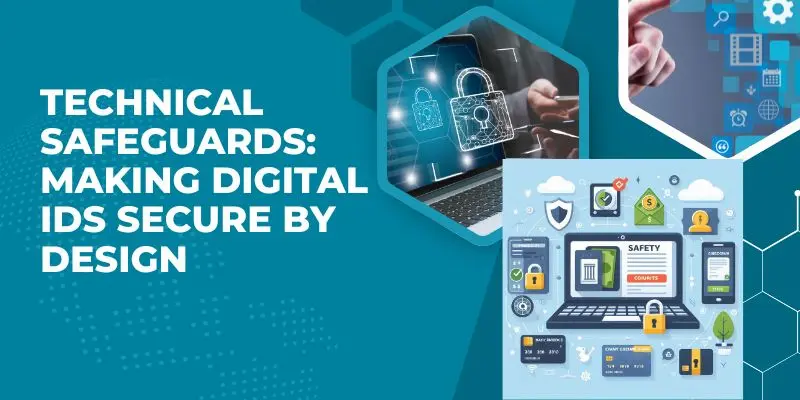
This section explores how Europe is designing digital ID systems to be resilient from the ground up, highlighting the practical safeguards that protect identity data and ensure trust in both government and private implementations.
Hardware Authentication: Strengthening the User Endpoint
At the front line of digital identity security is hardware-based authentication — physical devices that store and protect cryptographic keys securely. Instead of relying solely on passwords or SMS codes, users authenticate with hardware tokens, smartcards, or secure elements embedded in mobile phones (like Apple’s Secure Enclave or Android’s Trusted Execution Environment).
The idea is simple: separate sensitive operations from software. Hardware chips are isolated from general-purpose memory, making it nearly impossible for malware or phishing attacks to extract encryption keys. For example, when using the European Digital Identity Wallet (EUDI Wallet), the user’s private key can remain inside a secure hardware enclave that never leaves the device — authentication happens locally, with only cryptographic proofs transmitted to the verifier.
Some EU countries, such as Estonia and Finland, already employ national eID smartcards protected by tamper-resistant chips. Others are integrating FIDO2-compliant hardware keys that use asymmetric cryptography to ensure that even if an attacker gains access to servers, they can’t impersonate a user without physical possession of the device. This “something you have” factor drastically reduces credential theft risk — a major attack vector in centralized systems.
Cryptographic Decentralization: Removing the Single Point of Failure
Traditional identity systems rely on centralized databases, which create a single point of failure. A breach at one location can expose millions of records — as seen in several global ID leaks. To counter this, modern European frameworks are moving toward cryptographic decentralization, where verification occurs without storing all data in one place.
Under decentralized identity (DID) models, user credentials are issued by trusted authorities but stored locally by the user — either in their wallet app or distributed cryptographically across secure nodes. Verification happens using public-key infrastructure (PKI) and blockchain-based registries, ensuring that no central entity holds the full identity dataset.
The eIDAS 2.0 framework encourages member states to explore such architectures, emphasizing verifiable credentials that can be checked using cryptographic signatures rather than centralized databases. This approach significantly limits the damage from any single system compromise. Even if one node or authority is attacked, the attacker cannot reconstruct complete identity profiles.
Decentralization also enhances cross-border interoperability. A citizen in Spain could verify their identity for a German online service without either country’s databases needing to exchange raw personal data — only cryptographically verifiable proofs.
Multi-Factor Authentication (MFA): Layering Defense-in-Depth
Another cornerstone of digital ID security is multi-factor authentication (MFA) — the principle that identity verification should not depend on a single method. MFA typically combines at least two of the following:
- Something you know (like a PIN or password)
- Something you have (a hardware token, smartcard, or smartphone)
- Something you are (biometric traits like fingerprints or facial recognition)
The European Digital Identity Wallet aims to standardize MFA across member states. For instance, logging into an online government portal might require both biometric verification (via a smartphone sensor) and a hardware-stored key. This layered defense drastically reduces the likelihood of unauthorized access, even if one factor is compromised.
Importantly, the EU’s technical guidance stresses accessibility — ensuring that MFA remains inclusive for people with disabilities or limited technical resources. The use of mobile-based authenticators, SMS backups, and alternative verification methods ensures that no citizen is locked out of essential services.
Privacy-Enhancing Technologies: Protecting Data by Default
Security alone isn’t enough — privacy must also be engineered into every interaction. To achieve this, European digital ID systems are adopting privacy-enhancing technologies (PETs) that minimize data exposure.
One of the most promising is zero-knowledge proofs (ZKPs). With ZKPs, a user can prove something about their identity — for example, that they are over 18 — without revealing their exact birthdate or other personal details. This “selective disclosure” concept ensures that only the minimum necessary data is shared with each service provider.
Similarly, pseudonymization and data minimization techniques ensure that systems store only what’s needed for verification. Personal attributes (like name or address) can be cryptographically split or hashed so they can’t be linked across multiple services. This prevents large-scale tracking or profiling of users, a major civil-liberties concern.
Moreover, consent management systems are built into wallet interfaces. Before data is shared, users must explicitly approve what information is being transmitted and to whom — a digital equivalent of signing a consent form.
End-to-End Encryption and Secure Channels
Every communication between the user, issuer, and verifier is protected through end-to-end encryption (E2EE). This ensures that even if attackers intercept traffic, they cannot decipher the contents. TLS 1.3 and modern elliptic-curve cryptography (ECC) are standard protocols, combined with digital signatures that verify message integrity.
In practice, this means that when a citizen uses their EUDI Wallet to log into a bank or healthcare portal, no third party — including the government — can see the exchanged authentication data. Secure channels also mitigate man-in-the-middle (MITM) attacks, ensuring that credentials cannot be altered in transit.
Continuous Monitoring and Threat Response
Finally, “secure by design” doesn’t end at deployment. European systems increasingly rely on continuous monitoring, AI-driven anomaly detection, and real-time incident response. Security operation centers (SOCs) track login patterns, device fingerprints, and geolocation anomalies to flag suspicious activity.
When potential breaches occur, authorities can instantly revoke or re-issue digital credentials — a capability that traditional ID cards lack. The EU’s cybersecurity agency (ENISA) provides ongoing guidance and technical standards for member states to ensure that digital ID infrastructures evolve alongside threats.
From Theory to Trust
The combined use of these technologies — from hardware isolation and MFA to privacy-preserving cryptography — transforms digital IDs into a trustworthy foundation for Europe’s digital future. The philosophy is clear: even if one layer fails, others remain intact to protect users.
Ultimately, security by design ensures that citizens own their digital identities rather than surrendering them. It reflects a paradigm shift — from centralized control to distributed trust — where privacy and protection are not optional features but core design principles.
9. Policy and Governance: Building a Safe and Trusted Digital ID Future
As Europe races toward a fully digital future, policy and governance have become as critical as technology itself. Digital identity systems — from national eIDs to the European Digital Identity Wallet — are not just technical tools but public infrastructure. Their success depends on how they are governed: who sets the rules, who enforces them, and how citizens’ rights are safeguarded. Without robust governance and transparent oversight, even the most advanced digital ID architecture can erode trust instead of strengthening it.
This section explores how EU-wide standards, cross-border cooperation, transparent audits, and citizen-centric protections are shaping the governance of Europe’s digital identity ecosystem — ensuring that innovation doesn’t come at the cost of security, privacy, or public confidence.
The Governance Challenge: Aligning 27 Nations Under One Framework
Europe’s biggest strength — its diversity — is also its greatest challenge when building unified digital systems. Each EU member state has its own approach to identity verification, cybersecurity, and data protection. Some, like Estonia or Denmark, have long-established digital ID ecosystems; others are still developing theirs.
To harmonize these systems, the European Commission introduced eIDAS 2.0 (Electronic Identification, Authentication, and Trust Services Regulation), which mandates a common legal and technical foundation for all member states. This framework ensures that digital IDs issued in one country are recognized across borders — for example, a citizen from Italy can use their national ID to access public services in Germany or register a company in France.
However, uniformity goes beyond interoperability. It also requires consistent security standards, operational transparency, and regulatory oversight. Without these, discrepancies in how member states store data, verify credentials, or handle breaches could create weak points exploitable by attackers. Thus, policy coherence — not just technology — is central to Europe’s digital trust strategy.
Stronger EU-Wide Security Standards
At the heart of governance reform lies the need for strong, binding cybersecurity standards. The EU is working to ensure that every digital ID system meets a baseline level of protection — including encryption, data minimization, and identity-proofing procedures.
Organizations like ENISA (European Union Agency for Cybersecurity) play a key role here. ENISA provides detailed technical guidance on cryptography, risk management, and incident response. Under eIDAS 2.0, all wallet providers — public or private — must comply with ENISA-certified security frameworks, ensuring uniform protection across all borders.
Moreover, the EU’s Cyber Resilience Act (CRA) complements this effort by mandating that all digital products, including ID systems, be designed with cybersecurity built in from the start. This legal alignment ensures that technical safeguards (like multi-factor authentication and cryptographic decentralization) are enforced by policy, not left to voluntary compliance.
Continuous Audits and Certification Mechanisms
Trust must be verified continuously, not assumed. To ensure that digital ID systems remain resilient, the EU is introducing regular security audits, code reviews, and independent certifications. These audits examine every layer — from hardware to cloud infrastructure — to ensure compliance with data protection and cybersecurity regulations.
Certification under schemes like EU Cybersecurity Certification Framework (EUCC) provides formal assurance that a digital ID service meets high standards. For example, wallet providers must demonstrate secure key management, tamper-proof storage, and transparent consent handling.
Continuous monitoring also enables early threat detection. Real-time logging, vulnerability testing, and mandatory reporting protocols help identify weak points before they are exploited. The goal is to move from reactive breach management to proactive system hardening.
Transparent Breach Reporting and Accountability
One of the most crucial pillars of governance is transparency in incident management. If a data breach occurs, citizens must be promptly informed, and authorities must act swiftly to contain the damage. Under GDPR and eIDAS 2.0, digital ID operators are required to report breaches within 72 hours to both regulators and affected users.
But Europe’s governance framework goes further — it encourages open communication rather than secrecy. Instead of downplaying incidents, authorities are urged to disclose the scope, cause, and corrective actions publicly. This transparency helps rebuild public confidence and discourages negligent behavior by service providers.
Furthermore, accountability mechanisms ensure that responsibility is clearly assigned. If a wallet provider or national authority fails to protect user data, they face financial penalties, loss of certification, or even legal action. By enforcing clear liability rules, the EU ensures that all participants in the digital ID ecosystem — from software vendors to government agencies — share equal responsibility for maintaining trust.
Citizen Protection Frameworks: Putting People at the Center
Ultimately, the goal of digital ID governance is not just to protect data but to empower citizens. A truly secure and ethical system must uphold individual rights, including privacy, consent, and accessibility.
The EU’s approach emphasizes citizen control over personal data. Users must be able to see what information is stored, who accesses it, and for what purpose. Consent must be granular — not a blanket approval — allowing citizens to share only specific attributes (for example, proof of age instead of full identity).
Moreover, inclusion is a key governance principle. Policies must ensure that digital IDs do not exclude vulnerable groups — such as the elderly, low-income citizens, or those without advanced devices. Initiatives like public digital assistance centers and offline verification alternatives are designed to prevent a digital divide within identity systems.
Data protection officers, national supervisory authorities, and EU-level regulators form a multi-layered oversight structure that ensures no single entity — public or private — can unilaterally control or misuse citizen data. These bodies work together to enforce GDPR, eIDAS 2.0, and emerging digital rights laws.
Toward a Resilient and Trusted Digital Future
The evolution of digital identity in Europe reflects a profound policy vision: trust is not built by code alone but through accountability, transparency, and rights-based governance. Technical safeguards like encryption and hardware keys protect data; governance safeguards protect people.
To sustain public confidence, Europe must continue to refine its legal frameworks — introducing pan-European security baselines, mandatory certification, and citizen recourse mechanisms that make digital identity not just secure but democratic.
By combining cutting-edge technology with principles of fairness, oversight, and transparency, Europe is building more than an ID system — it’s constructing a new layer of digital citizenship. One where every citizen can interact securely online, confident that their identity belongs to them and not to the system that verifies it.
Conclusion
Digital ID Systems in Europe represent both ambition and caution — a determination to simplify life for citizens while fiercely protecting their rights in the digital realm. Europe’s journey toward a unified digital identity framework stands out globally because it doesn’t view security, convenience, and privacy as opposing goals, but as pillars of the same trusted system.
The evolution of national eIDs, the emergence of the European Digital Identity Wallet, and the rollout of eIDAS 2.0 all demonstrate a clear commitment: digital progress must never come at the expense of individual freedom. Yet, achieving this balance requires constant vigilance. As Digital ID Systems in Europe become gateways to essential services, they also become high-value targets for cybercriminals and potential tools of overreach.
The strength of Europe’s digital future will depend not only on cryptographic safeguards or technical standards, but also on the governance frameworks, ethical oversight, and user empowerment that protect them.
Ultimately, a trusted digital identity system is not just about proving who we are — it’s about defining how much control we retain over our digital selves. The success of Digital ID Systems in Europe will be measured by their ability to make digital identification not a symbol of surveillance, but a foundation for freedom, inclusion, and trust in an increasingly interconnected world.
FAQs
The European Digital Identity Wallet is a secure digital app that allows citizens and businesses to store and share verified credentials like ID cards, driving licences, diplomas, or bank information. It gives users complete control over which data they share, ensuring privacy and security. The system is built so you can use it across all EU countries, making identification and verification seamless for cross-border services.
No, using the wallet is completely optional. It doesn’t replace your traditional physical ID or passport; it simply adds a convenient digital option. You can still use your normal ID if you prefer, but the wallet makes it easier to access online services securely, especially when dealing with organisations in other EU member states.
The wallet will be accepted for a wide range of services, both public and private. You can use it to log in to government portals, open bank accounts, enrol in universities, or verify your age online. Over time, more companies and agencies across Europe will integrate with the system, making it a universal tool for secure digital identification.
The wallet uses strong encryption, authentication, and verification technologies to protect users from hacking and identity theft. It supports multi-factor authentication and selective data sharing, meaning you can share only the necessary details instead of your full identity. Each wallet must also meet EU-approved security standards before being issued.
Privacy is one of the main priorities of the system. You choose what information to share and when, with complete transparency. The wallet supports data minimisation and selective disclosure, meaning you can, for example, confirm that you’re over 18 without revealing your exact birth date. Your data always remains under your control.
If your device is lost or stolen, your digital wallet can be revoked and reissued by the national authority. Recovery options like identity verification and secure backup will help you regain access quickly. It’s still important to protect your phone with strong passwords, biometric locks, or PINs to prevent unauthorized access.
No, the European framework requires accessibility for everyone. Alternative solutions will be provided for citizens who don’t have smartphones or digital literacy skills. Governments are expected to ensure inclusivity so that digital identity tools do not exclude older adults or people living in remote areas.
Every EU member state will issue a national version of the wallet that follows common technical standards. This ensures that a digital identity issued in one country will be recognised and trusted in another. It allows seamless cross-border access to services without needing to register or verify again in each country.
Private organisations, such as banks or online platforms, can only access the specific details they need — and only with your permission. They cannot see your full identity information or store your data without consent. Clear accountability rules are in place to ensure misuse or breaches are strictly punished.
The rollout is expected to be completed by 2026, with full acceptance across EU countries by around 2027. Some pilot projects are already in testing stages in several member states. Once officially launched, all EU citizens and residents will be able to request and use their own verified digital identity wallet.

Ethical Hacking for Social Goods: How Hackers Are Protecting the World, Not Breaking It





- Be Respectful
- Stay Relevant
- Stay Positive
- True Feedback
- Encourage Discussion
- Avoid Spamming
- No Fake News
- Don't Copy-Paste
- No Personal Attacks
- Be Respectful
- Stay Relevant
- Stay Positive
- True Feedback
- Encourage Discussion
- Avoid Spamming
- No Fake News
- Don't Copy-Paste
- No Personal Attacks
