Firewall AI Tools for Business – The Smart Way to Secure Your AI Systems
Published: 29 Oct 2025
Firewall AI Tools for Business are redefining cybersecurity in the modern digital age. Artificial Intelligence is transforming how businesses operate—but it’s also opening new doors for cyber threats. Hackers now target AI systems, not just networks. That’s where these smart AI firewalls come in. They don’t just block attacks; they understand, adapt, and learn from them. From preventing data leaks and stopping malicious prompts to safeguarding sensitive AI models, Firewall AI Tools for Business act as your company’s silent bodyguard. Let’s uncover how they keep your business—and its AI—truly safe.
1. Understanding AI Firewalls and Their Role in Modern Security
An AI firewall is an advanced cybersecurity tool designed to protect artificial intelligence systems and large language models (LLMs) from modern digital threats. It works as a smart layer of defense that monitors, filters, and controls how AI systems interact with users and data. Just like the Best AI Tools for Business help companies automate and grow safely, AI firewalls ensure these systems stay secure, reliable, and free from harmful attacks.
Unlike traditional firewalls, which focus only on blocking unsafe network traffic, AI firewall tools understand the context behind every interaction. They use Natural Language Processing (NLP) and Language Security Processing (LSP) to detect malicious prompts, hidden commands, or suspicious patterns that could harm your AI applications.
A standard or Next-Generation Firewall (NGFW) protects your network. But an AI-powered firewall protects your AI brain—your chatbots, generative models, and data-driven tools. It analyzes prompts, filters responses, and adapts to new attack methods using machine learning and real-time threat detection.
This intelligent approach makes AI firewalls essential in today’s AI cybersecurity landscape. As more companies use AI for automation, data analysis, and customer support, the risks of data leaks, model manipulation, and privacy violations grow. An AI firewall ensures safe, compliant, and trustworthy AI operations by acting as a digital shield around your most valuable systems.
2. Why Businesses Need AI-Powered Firewalls
AI adoption in business is growing faster than ever. From chatbots that handle customers to tools that write code or analyze data, artificial intelligence has become a core part of daily operations. But as companies use more AI, new kinds of cyber threats are emerging—smarter, faster, and harder to detect.
Attackers are now targeting the very systems that power AI. Techniques like prompt injection, data exfiltration, and LLM manipulation are being used to trick AI models into revealing private or sensitive information. A simple command or hidden instruction in a prompt can lead to massive data leaks, system errors, or loss of trust.
That’s why businesses today need AI-powered firewalls—security tools built specifically to understand and protect intelligent systems. These firewalls use Natural Language Processing (NLP) and Language Security Processing (LSP) to identify harmful text, detect manipulated prompts, and stop unauthorized data transfers before they happen.
Beyond protection, AI firewalls bring visibility, control, and compliance. They help organizations monitor how their AI systems handle information, keeping user data secure while meeting strict privacy standards.
In a world where AI cybersecurity threats grow by the minute, having a traditional firewall isn’t enough. An AI firewall gives businesses the power to defend not just their networks, but also their AI models, language systems, and data pipelines—the true engines of modern innovation.
3. How AI Firewalls Work
AI firewalls don’t just block data—they think before they act. These intelligent systems use machine learning, Natural Language Processing (NLP), and Language Security Processing (LSP) to analyze every message, prompt, and response that passes through your AI tools.
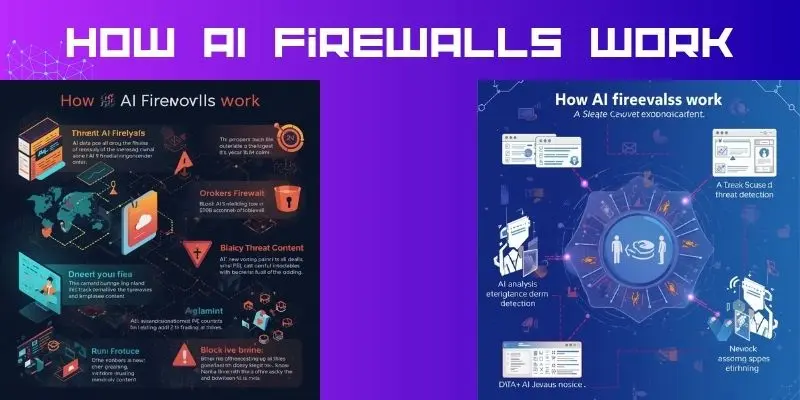
The process starts with inspecting AI inputs. Before an AI model receives a command, the firewall scans it for hidden instructions, unsafe requests, or malicious code. This helps stop prompt injection attacks that try to trick the model into revealing private or restricted data.
Next comes filtering AI outputs. Even after an AI model generates a response, the firewall checks it again to make sure no confidential data or personal information is accidentally exposed. This keeps your LLM (Large Language Model) interactions safe and compliant.
An AI-powered firewall also uses real-time anomaly detection. It learns what normal activity looks like and quickly flags anything unusual—like strange data requests or sudden behavior changes in your model.
Another smart feature is its ability to adapt security rules dynamically. Instead of relying on fixed rules like traditional firewalls, it continuously updates its defenses as new threats appear. Whether your AI system runs in the cloud, on-premises, or at the edge, it stays protected.
In short, an AI firewall acts as a guard, teacher, and learner all at once—analyzing inputs, monitoring outputs, and improving with every interaction. This is how it keeps your AI applications safe from evolving LLM threats, data breaches, and prompt-based attacks without slowing down performance.
4. Key Features and Capabilities of AI Firewall Tools
AI firewall tools come loaded with smart, adaptive features that keep your AI systems safe, fast, and reliable. These tools use machine learning, NLP (Natural Language Processing), and LSP (Language Security Processing) to deliver protection that goes far beyond traditional firewalls.
1. Advanced Threat Detection
AI firewalls continuously scan for risks like prompt injections, data exfiltration attempts, and LLM misuse. They don’t just rely on known patterns—they learn from behavior and language context, spotting new types of attacks before they cause harm.
2. Real-Time Traffic Analysis
Every piece of data that flows through your AI system is inspected in real time. The firewall tracks AI inputs, model responses, and API interactions, instantly flagging anything that looks unusual or unsafe. This ensures ongoing AI cybersecurity without interrupting business operations.
3. Automated Response Mechanisms
When a threat is detected, the AI-powered firewall acts automatically—blocking the attack, isolating the source, and alerting the admin. These quick, self-learning responses help prevent downtime and data loss, keeping systems secure around the clock.
4. Multi-Model Awareness
Modern businesses use more than one AI model or chatbot. An AI firewall supports multiple LLMs at once, maintaining context awareness across them. It ensures consistent protection for all your models, whether they’re customer-facing, internal, or third-party integrated.
5. Secure On-Premise and Cloud Deployment
Flexibility is key. AI firewall tools can be deployed on-premises, in the cloud, or at the edge, depending on your company’s setup. They’re designed for low latency and high throughput, so your security stays strong without slowing down performance.
5. Core Benefits of AI Firewalls for Businesses
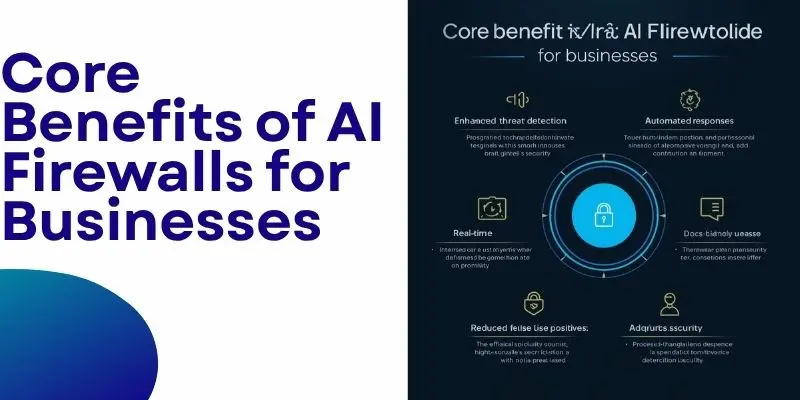
AI firewalls don’t just add another layer of defense—they bring real business value. These tools combine AI cybersecurity, NLP analysis, and LSP-driven detection to protect your systems, data, and customer trust all at once.
1. Strong Data Protection
An AI-powered firewall shields sensitive data from leaks, theft, or misuse. It keeps personal information, company secrets, and training data safe by stopping prompt injection and data exfiltration attacks before they happen.
2. Compliance Made Simple
Many industries must follow strict privacy laws like GDPR, HIPAA, or ISO standards. AI firewalls help you stay compliant by automatically filtering out sensitive data, monitoring AI interactions, and keeping detailed logs for audits.
3. Fewer Security Breaches
Traditional firewalls can miss hidden AI threats, but AI firewall tools catch them early. Their real-time threat detection and automated response system reduce the risk of data breaches, minimizing downtime and financial losses.
4. Cost Efficiency and Smart Scaling
Preventing a cyberattack is always cheaper than fixing one. By using machine learning to detect and stop threats early, AI firewalls save both time and money. They scale easily with your AI usage—no heavy setup or extra hardware needed.
5. Builds Trust in AI Systems
Customers and teams need to trust that your AI is safe and ethical. With AI firewall protection, your business ensures every response, model, and data transaction is secure. That trust leads to better brand reputation and stronger customer loyalty.
6. Comparing AI Firewalls with Traditional Security Gateways
Traditional firewalls, including Next-Generation Firewalls (NGFWs), were built to protect networks—not AI systems. They focus on controlling traffic, blocking malware, and filtering unauthorized access. While they’re still useful, they can’t fully handle the complex behavior of modern AI models.
An AI-powered firewall, on the other hand, is designed specifically for the AI era. It doesn’t just watch data packets—it understands language, intent, and context using Natural Language Processing (NLP) and Language Security Processing (LSP). This makes it capable of detecting attacks hidden in AI prompts or responses that a traditional firewall would miss.
Here’s a quick breakdown of how they differ:
| Feature | Traditional NGFW | AI-Powered Firewall |
| Focus Area | Network traffic and IP-based threats | AI models, data pipelines, and LLM interactions |
| Detection Method | Fixed rules and signatures | Context-aware NLP and adaptive learning |
| Threat Response | Manual or semi-automated | Fully automated with self-learning defense |
| Data Awareness | Limited visibility | Deep understanding of AI inputs, outputs, and language |
| Adaptability | Static updates | Dynamic rule adaptation based on live AI behavior |
AI firewalls are proactive, not reactive. They analyze every input and output of your Large Language Models (LLMs), identifying hidden threats like prompt injections, data poisoning, or model manipulation.
In simple words:
A traditional firewall protects your network, while an AI firewall protects your intelligence—the part of your business that learns, predicts, and makes decisions.
By combining machine learning, real-time threat detection, and context awareness, AI firewalls adapt to evolving cybersecurity risks faster than any traditional system can.
7. Top Use Cases and Applications in Business
AI firewalls are no longer experimental—they’re becoming a core part of business security. From startups to large enterprises, companies are using these tools to keep their AI systems safe, compliant, and reliable. Here’s how businesses are applying AI firewall tools in the real world:
1. Securing Custom or Third-Party AI Models
Businesses often train or integrate AI models that handle sensitive data. An AI-powered firewall ensures these models stay protected from prompt injections, LLM exploits, and data manipulation. Whether it’s a homegrown chatbot or a third-party API, the firewall constantly monitors and filters every input and output using NLP and LSP analysis.
2. Protecting Enterprise Workflows
Many companies rely on AI-driven automation for customer support, HR, and analytics. A single breach could stop these systems or expose private data. AI firewalls keep workflows running safely by blocking harmful requests, detecting anomalies, and preventing data exfiltration in real time.
3. Preventing Shadow AI
“Shadow AI” refers to unauthorized AI tools used by employees without IT approval. These tools often create unseen security risks. An AI firewall helps detect and control shadow AI usage by tracking data flows, recognizing suspicious AI endpoints, and ensuring all AI activity follows company security policies.
4. Mitigating Data Leaks and Prompt-Based Attacks
AI models can accidentally reveal sensitive details through poorly designed prompts or responses. Firewalls with language-level security scan prompts for hidden commands and filter outputs that may leak private data. This keeps your AI cybersecurity strong while maintaining data privacy and compliance.
8. Leading AI Firewall Tools and Platforms
As AI security becomes a business priority, several advanced tools have emerged to protect enterprises from evolving AI-driven risks. Here are some of the top AI firewall platforms making a real impact today:
1. Cloudflare Firewall for AI
Cloudflare’s AI Firewall is designed specifically for large language models (LLMs) and AI APIs. It analyzes every prompt and response in real time, blocking harmful or sensitive data exposure. What sets it apart is its integration with Cloudflare’s global network, enabling instant protection at scale without adding latency. For organizations already using Cloudflare for web security, this tool provides seamless AI-layer defense and compliance support.
2. Polymer AI Firewall
Polymer’s AI Firewall focuses on data privacy and compliance for companies using generative AI tools like ChatGPT, Google Gemini, or internal LLMs. It automatically masks or redacts confidential data before it reaches the model, helping businesses prevent data leaks, PII exposure, and shadow AI risks. Its standout feature is real-time monitoring with built-in GDPR and SOC 2 compliance, making it ideal for regulated industries.
3. Aim AI Gateway
Aim AI Gateway offers a developer-focused firewall that protects AI model endpoints and API calls. It provides advanced rate limiting, prompt filtering, and context-aware security, helping companies safeguard their AI applications from prompt injection attacks, data poisoning, and unauthorized model queries. Its modular architecture makes it popular among startups and AI-first companies that need flexibility with strong protection.
Each of these platforms represents a major step toward intelligent, adaptive AI security. Whether you’re running in the cloud or on-premise, these firewalls give your business the power to build safely, deploy confidently, and innovate securely.
9. Implementing an AI Firewall Without Complexity
Setting up an AI firewall doesn’t have to be complicated. Modern solutions are designed with deployment flexibility and low technical friction in mind, allowing businesses to start protecting their AI systems quickly — whether in the cloud, on-premises, or at the edge.
A good AI firewall integrates smoothly with existing security stacks, including API gateways, identity systems, and LLM-powered workflows. This means you don’t need to rebuild your infrastructure — the firewall simply adds an intelligent layer of defense on top of what you already use.
When implemented properly, the firewall continuously analyzes Natural Language Processing (NLP) inputs and Large Scale Processing (LSP) data flows to detect threats early without affecting performance. Its adaptive machine learning engine ensures that even as AI models evolve, your protection stays one step ahead.
Another key advantage is scalability. AI firewalls automatically adjust to your usage volume — whether you’re processing thousands of prompts or millions — while maintaining low latency and high throughput. This balance between speed and safety makes them ideal for businesses of all sizes, from startups to global enterprises.
In short, implementing an AI firewall is no longer a heavy IT project — it’s a plug-and-secure upgrade that brings instant visibility, compliance, and peace of mind to your AI ecosystem.
10. Beyond Firewalls: Building a Complete AI Security Strategy
AI firewalls are the first line of defense, but they’re only one part of a complete AI security ecosystem. To truly safeguard business data and maintain trust, organizations must think beyond blocking threats — they need to build a responsible, layered protection strategy.
A strong AI security strategy combines continuous monitoring, auditing, and governance. Real-time analytics help detect unusual patterns in Natural Language Processing (NLP) outputs or Large-Scale Processing (LSP) models, while automated audits ensure compliance with data privacy standards. This holistic approach gives businesses clear visibility into how their AI systems behave and how data flows across every model and endpoint.
Equally important is responsible AI governance — defining ethical standards, usage boundaries, and internal policies that keep AI transparent and accountable. When firewalls, policies, and people work together, organizations can prevent misuse, reduce bias, and ensure AI remains an asset rather than a risk.
Conclusion
In a world where AI drives every digital interaction, Firewall AI Tools for Business have become essential for protecting data, models, and customer trust. These advanced systems go far beyond traditional firewalls—leveraging machine learning, NLP, and adaptive intelligence to defend against evolving threats like prompt injections and data exfiltration. For businesses, investing in Firewall AI Tools for Business isn’t just a security upgrade—it’s a commitment to safe, ethical, and scalable innovation. As cyber threats evolve, the companies that secure their AI today will lead the future with confidence tomorrow.
FAQs
AI is used in firewalls to detect and stop modern cyber threats that traditional systems can’t handle. It analyzes network behavior, detects unusual patterns, and blocks malicious traffic in real time. With NLP (Natural Language Processing), AI firewalls can even scan text-based inputs from chatbots or LLMs to prevent prompt attacks. This makes AI firewalls faster, smarter, and more adaptive than standard security tools.
The best AI tool for business depends on your needs — but popular options include Cloudflare Firewall for AI, Polymer AI Firewall, and Aim AI Gateway for security. For general business automation, tools like ChatGPT, H2O.ai, and Jasper AI are widely used. Each offers strong Large-Scale Processing (LSP) and data protection features that support productivity and safety together.
AI tools can be divided into four main types: Reactive AI, Limited Memory AI, Theory of Mind AI, and Self-Aware AI. Reactive AI performs simple tasks, while Limited Memory AI — used in most firewalls — learns from data and adapts. Theory of Mind AI focuses on understanding users, and Self-Aware AI is still in research. Businesses mainly use the second type for automation and cybersecurity.
The 30% rule in AI suggests that around one-third of business tasks can be automated or improved using AI technology. This includes areas like workflow automation, data analysis, and cybersecurity management. AI firewalls apply this rule by handling about 30% of threat detection and response automatically — reducing workload and improving protection efficiency.
Businesses rely on AI firewalls to defend against prompt injection, data theft, and malicious AI behavior. Traditional firewalls can’t analyze LLM interactions or NLP-based inputs, but AI-powered ones can. They protect both customer data and internal models, ensuring compliance, safety, and trust in AI-driven systems.
AI firewalls use advanced algorithms and machine learning to study normal traffic patterns. When an abnormal activity occurs — such as suspicious API calls or unauthorized AI prompts — they trigger alerts or block actions instantly. Over time, they learn from every attack attempt, improving accuracy without manual updates.
Yes, AI firewalls can protect chatbots, customer assistants, and virtual agents by analyzing every input and output. They filter harmful prompts, block NLP-based exploits, and ensure responses stay ethical and safe. This is especially useful for businesses using generative AI to interact with customers daily.
Next-Generation Firewalls (NGFWs) focus on network-level security, while AI firewalls go deeper — protecting AI models, APIs, and data pipelines. NGFWs rely on fixed rules, but AI firewalls continuously learn and adapt. They can detect subtle LLM attacks, analyze large-scale data (LSP), and respond faster to unknown threats.
No, most modern AI firewalls are built for easy integration. Businesses can deploy them on-premise, in the cloud, or at the edge — depending on their setup. These systems offer low latency, high scalability, and compatibility with existing tools, making AI-based protection accessible to companies of all sizes.
The future of cybersecurity is fully AI-driven. Firewalls will become more autonomous, predictive, and capable of real-time LSP data analysis. As threats grow smarter, AI will evolve to anticipate attacks before they happen. Businesses that adopt AI security early will lead the digital era with stronger defense and faster innovation.






- Be Respectful
- Stay Relevant
- Stay Positive
- True Feedback
- Encourage Discussion
- Avoid Spamming
- No Fake News
- Don't Copy-Paste
- No Personal Attacks
- Be Respectful
- Stay Relevant
- Stay Positive
- True Feedback
- Encourage Discussion
- Avoid Spamming
- No Fake News
- Don't Copy-Paste
- No Personal Attacks
